PRTO: The 80/20 Life Operating System
PRTO is the best 80/20 app for people who want leverage over hustle. You capture everything into areas (day job, side project, personal), declare your lens, find your top 20%, and pick your top 3 for focus. The 80% stays captured but out of the way. 14-day free trial, then $7/mo. You won't be charged until your trial ends. Cancel anytime.
Stop hustling. Start leveraging.
Most people get the 80/20 rule wrong. They think it means "work 80%, rest 20%," which is slicing one pie. The rule actually describes two separate distributions: a minority of causes producing a majority of effects. The power isn't in knowing the ratio. It's in choosing what you measure against before you find your 20%.
Which is where most productivity tools fail. They give you a list, a calendar, a kanban board, and they say "organize this." But they never ask the question that matters: what are you optimizing for? Without a lens, your "priorities" are just your inbox in another order.
PRTO is different. It's not a task manager with a priority feature bolted on. It's a leverage tool built on the two-distribution model. Capture everything, declare your lens, find your top 20%, pick your top 3. The 80% stays visible but out of the way, so you stop re-deciding every morning.
The problem: everything feels urgent, nothing compounds
You know the feeling. Your task list is 40 items deep. Everything feels urgent. You work hard all day, cross off 15 things, and tomorrow the list is longer than it was this morning. You're busy, you're tired, and nothing you shipped this week will matter in three months.
That's the hustle model, and it's the single-distribution misread turned into a work style. It treats every task as roughly equal and tries to raise the floor by doing more. The result is motion without leverage. You're spending hours on the 80% and protecting none of the 20%, which means you're exhausting yourself on work that doesn't compound.
The trap is that hustle feels virtuous. Society rewards visible effort, not visible selection. But the person who looks less busy and ships more is running the better system, because they're operating on two distributions, not one.
The reframe: 80/20 as a life principle
The 80/20 rule isn't a business rule of thumb. It's a life principle. Roughly 20% of what you do produces about 80% of what matters. The same imbalance shows up in work, in relationships, in health, in the side project you nurture on nights and weekends.
The reframe is from "how do I get through this list?" to "which 20% of this list actually matters?" And the answer depends on your lens, which is the frame you measure against. Urgency: what must be done to keep the world off your back? Goals: what moves me toward the future I want? Same list, different 20%, because the lens determines what counts as "the few that matter."
This is what makes PRTO an essentialism app, not a task manager. Essentialism, the philosophy Greg McKeown writes about, says do less but better. The 80/20 rule is the math behind it. The lens is what makes "essential" concrete, because it asks: essential under which frame?
How PRTO works
PRTO turns the 80/20 method into a product. Four steps, repeated weekly.
1. Capture everything into areas
You don't have one life. You have a day job, a side project, a personal life, and they're all fighting for the same attention. PRTO groups your life into areas, each with its own task list. You capture everything into the area it belongs to, without sorting or ranking yet. Just get it out of your head.
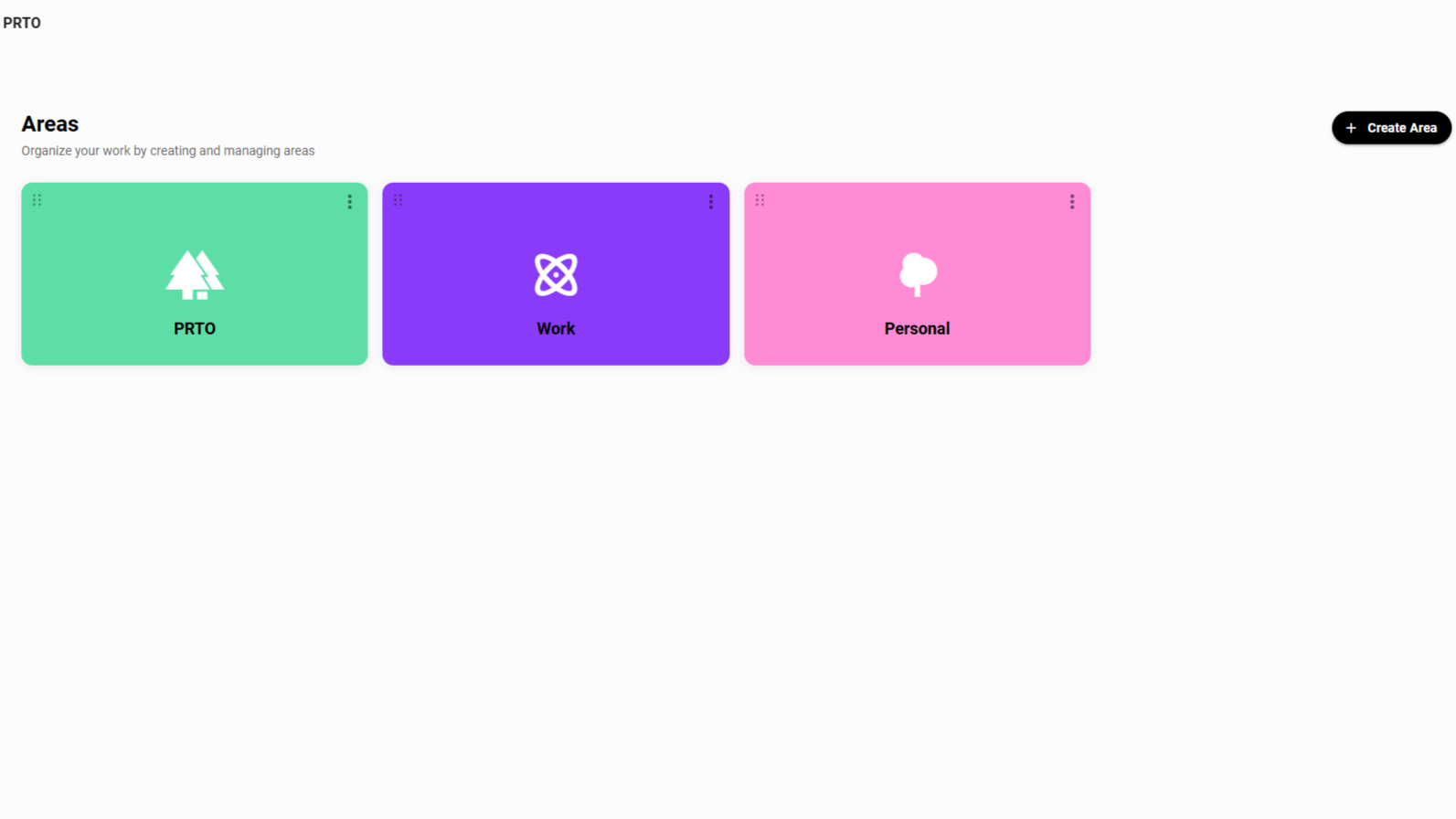
Inside each area, your tasks live in a tree structure, so you can break a big project into its pieces without losing the parent context.
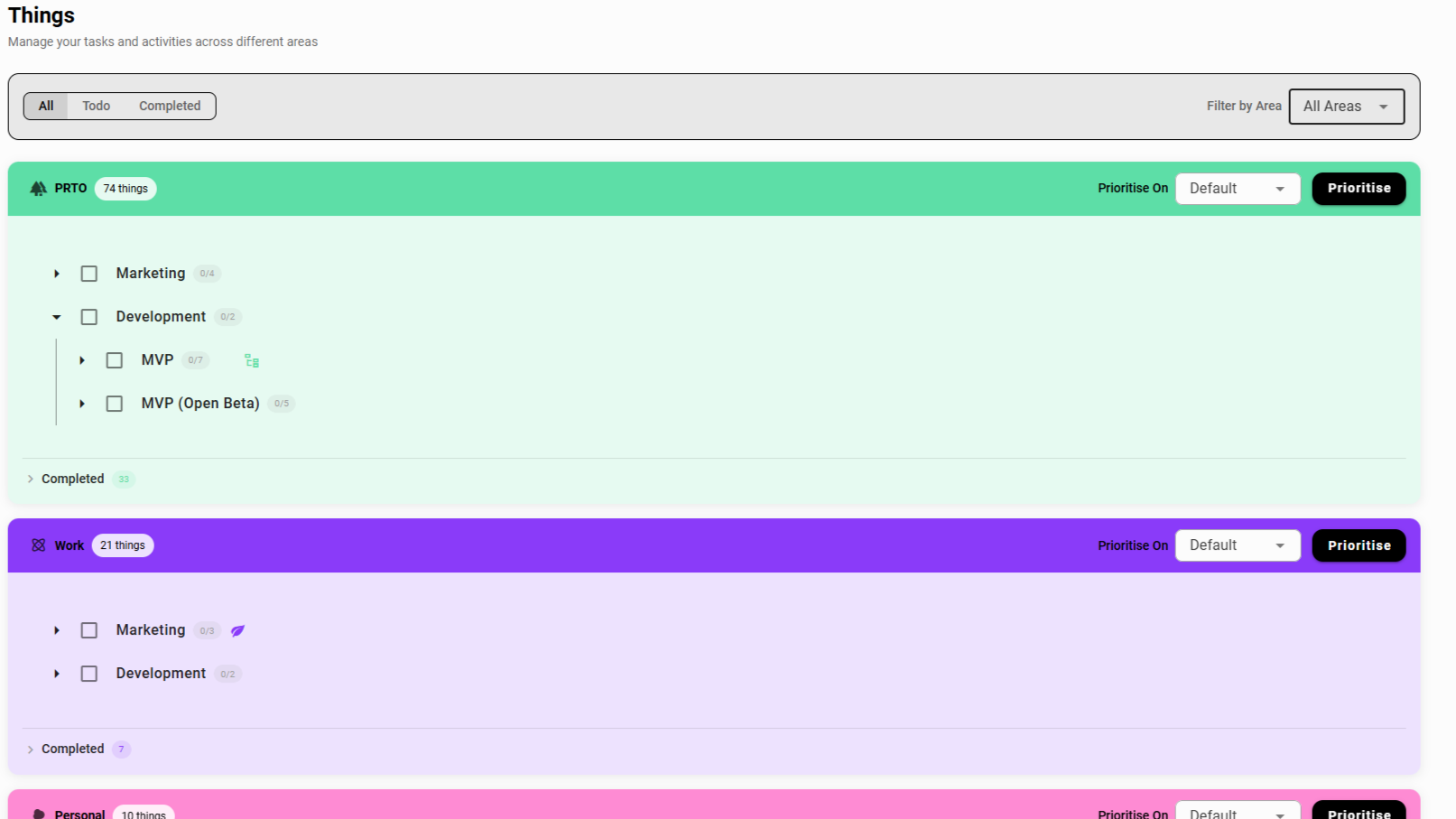
2. Declare your lens
Before you find your 20%, you pick what you're measuring against. PRTO gives you a priority lens toggle: goal-oriented or urgency-oriented.
- Goal lens: which of these move me toward the future I want? Your 20% is the work that compounds.
- Urgency lens: which of these must be done to keep the world off my back? Your 20% is what prevents pain right now.
Same list, two distinct 20% sets. The lens isn't a detail. It's the input that determines everything after it, and a 20% found without a frame is just "anything that felt key," which is usually "anything that felt urgent."
3. Find your top 20%
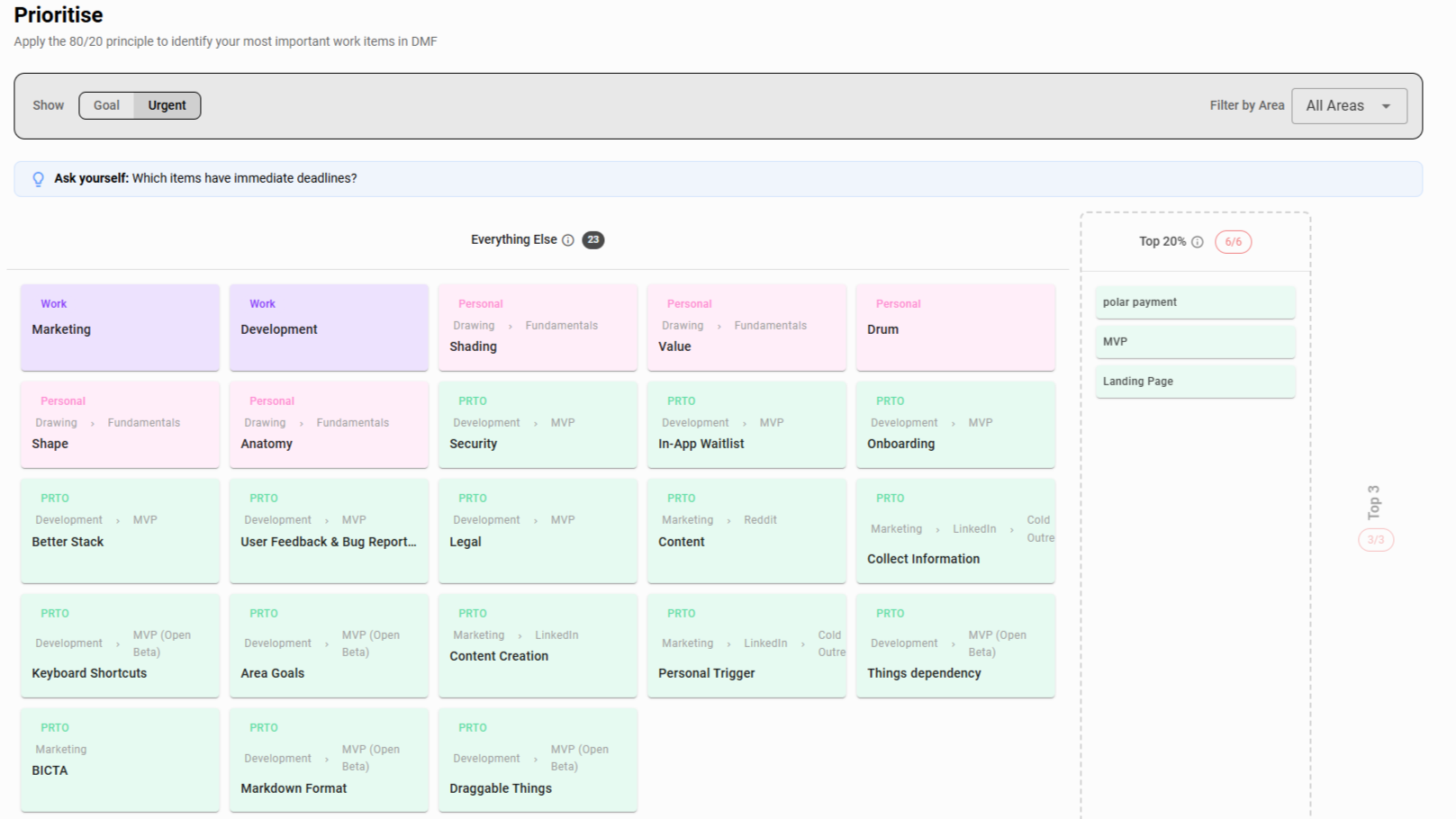
Look at your full list through the lens you chose. Drag the high-leverage items into the top 20% column. You're not ranking yet. You're separating the few that count from the low-leverage majority.
A useful rule of thumb: if a task's outcome is invisible a month from now under your chosen lens, it's probably in the 80%. If its outcome compounds under that filter, it's probably in the 20%.
Want to go deeper? Run the cascade. Treat your 20% as a new 100%, find the 20% within it (the 4% that drives 64% of results), and zoom in again (0.8% that drives 51%). Each level is a smaller mirror of the last. You're not adding new information. You're zooming in on the same axis until you hold the one thing that matters most under that lens.
4. Pick your top 3
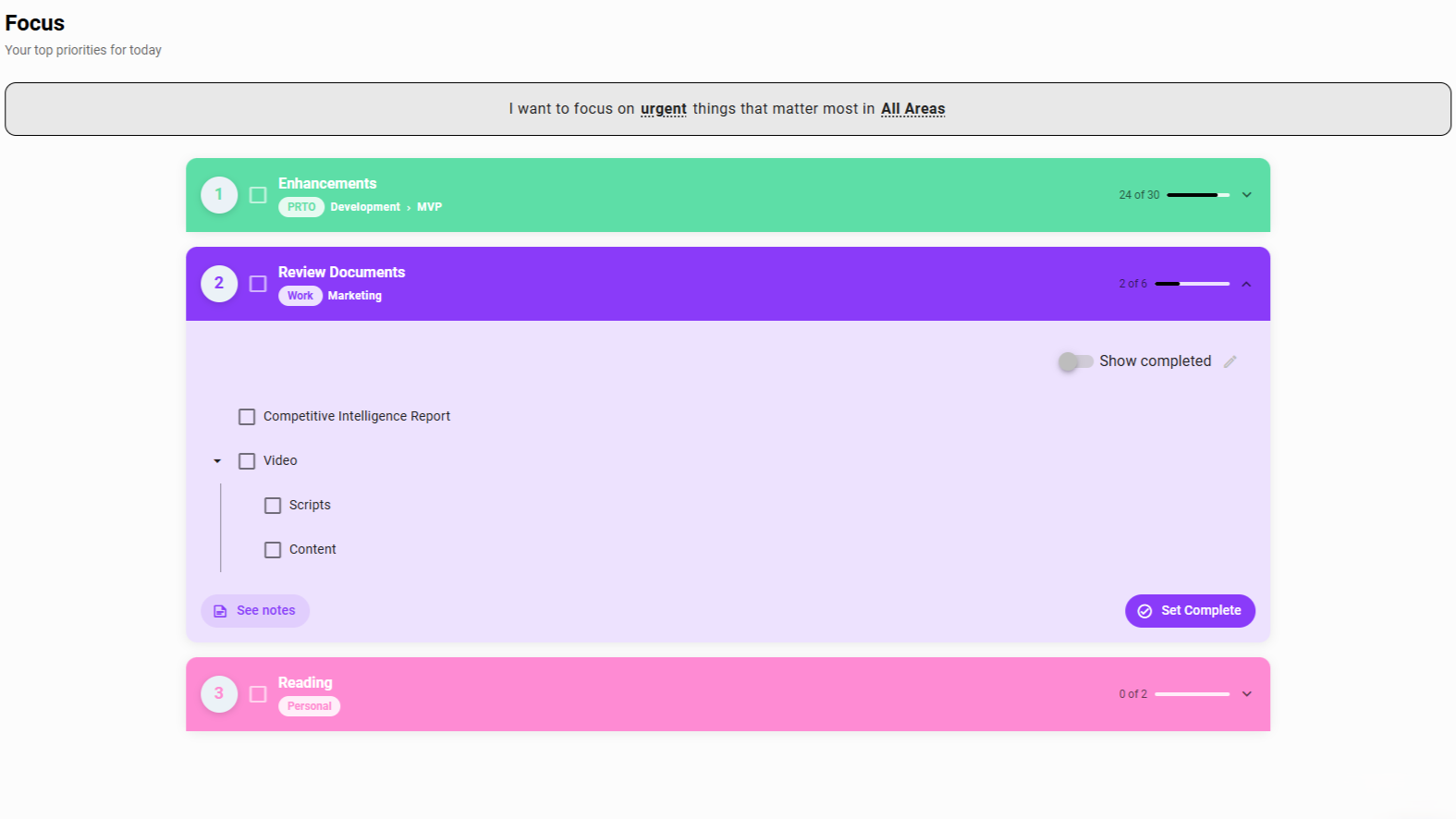
From your 20%, pick the 3 items that matter most right now. Not 10, not 7: three. The constraint forces honest selection, because if all of it is a priority, nothing is.
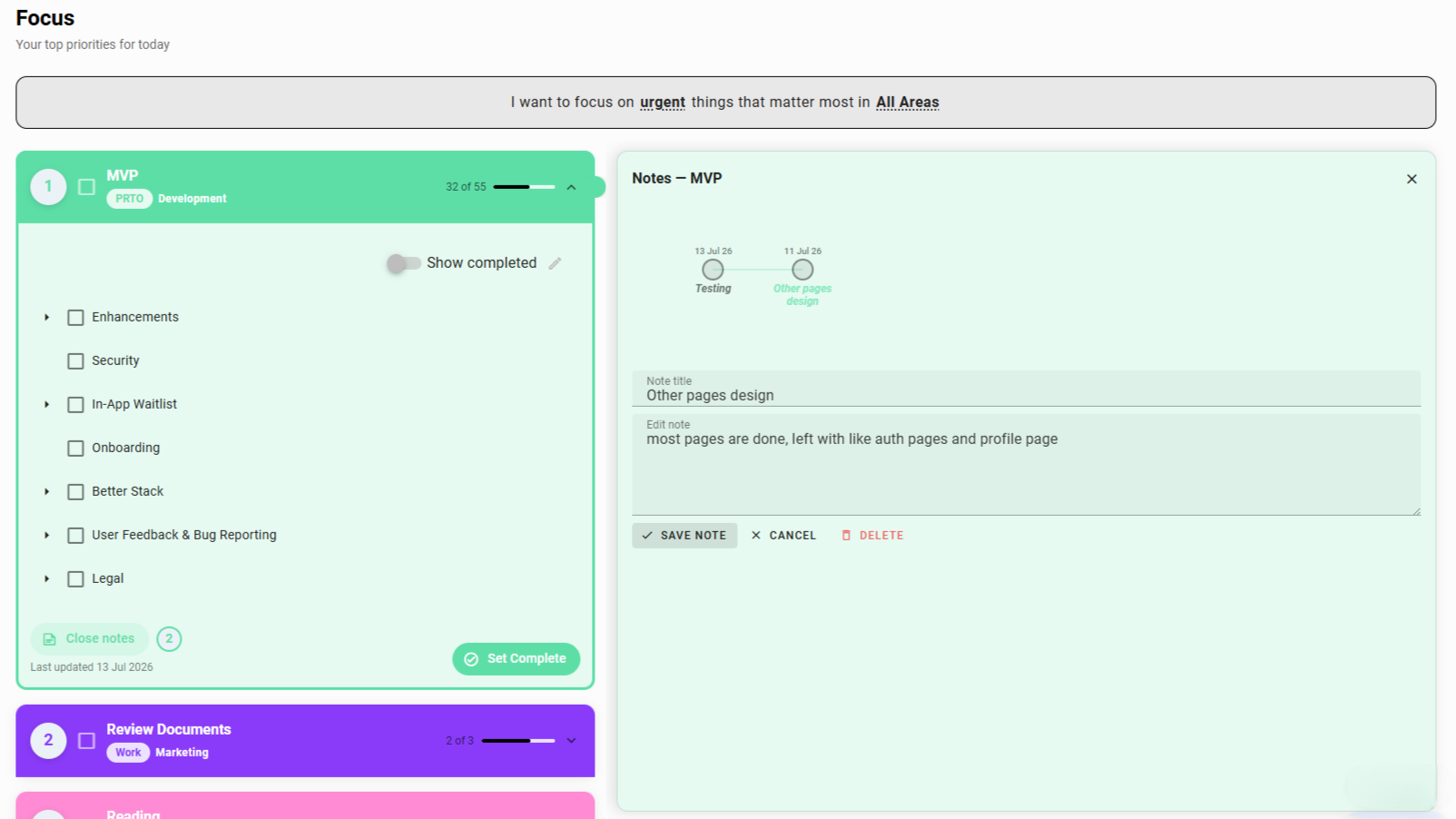
The Focus page shows your top 3, clean and stable. No due dates, no calendar, no 12-column kanban. Just the three things you decided matter, visible and protected.
The intersection: where your worlds overlap
Once you've ranked your tasks under the urgency lens and under the goal lens, you have two 20% sets. The Focus overview shows the intersection: items in both your urgency-20% and your goal-20%. This is work that is simultaneously what you owe now and what moves your life forward.
The intersection is rare, and it's also the most valuable work you can do, because it serves both distributions at once. You're not choosing between surviving and building. You're finding the work that does both.
Works alongside your existing tools
PRTO is being built to sit on top of your existing tools. Asana boards, Jira backlogs, Notion pages: each becomes an area. PRTO surfaces your top 3 across all of them, so you stop context-switching between five apps to figure out what matters today.
This is on the roadmap, not shipping today. The beta runs on manual capture, which means you add your tasks directly into PRTO. The integration layer comes next.
The books tell you what to think. PRTO tells you how to do it.
PRTO is the tool that operationalizes what Greg McKeown writes about in Essentialism and what Tim Ferriss preaches in 4-Hour Workweek. The books tell you to focus on the vital few. PRTO gives you the lens, the 20% column, the top 3, and the intersection that makes "the vital few" concrete and repeatable.
It's not a task manager that learned the word "priority." It's a leverage tool built on the two-distribution model from the ground up.
Pricing
$7/month after a 14-day free trial. You won't be charged until your trial ends. Cancel anytime during the trial and you won't be charged.
Frequently asked questions
What is PRTO?
PRTO is the 80/20 life operating system. It's not a task manager with a priority feature. It's a leverage tool built on the two-distribution model: you capture everything into areas (day job, side project, personal), declare your lens, find your top 20%, and pick your top 3 for focus. The 80% stays captured but out of the way. The goal isn't to get through your list. It's to stop hustling and start leveraging.
Is PRTO free?
PRTO offers a 14-day free trial, then $7/month. You won't be charged until your trial ends. Cancel anytime before then and you won't be charged at all.
How is PRTO different from other task managers?
Three differences. First, PRTO is priority-first, not date-first. There are no due dates, no calendars, no kanban columns. The core interaction is selecting your top 20% and your top 3, not scheduling tasks. Second, PRTO uses cascading 80/20: you find your 20%, then the 20% within that (4%), then the 20% within that (0.8%), zooming in until you hold the one thing that matters most. Third, PRTO has the lens concept: you declare what you're measuring against (goals or urgency) before you find your 20%, which means your priorities are based on a frame you chose, not whatever felt loud.
What is the 80/20 life operating system?
It's a category reframe. Most productivity tools are task managers: they help you organize and schedule work. PRTO is a life operating system built on the 80/20 rule, which means it starts from the assumption that 20% of your effort produces 80% of your results, and the tool's job is to help you find that 20% and protect it. The "life" part means it works across all your contexts (day job, side project, personal), not just your work inbox. The "operating system" part means it's the layer that decides what to work on, which sits above your task list, not inside it.
Does PRTO integrate with Asana, Jira, or Notion?
Integration is on the roadmap, not shipping today. PRTO is being built to sit on top of your existing tools, so Asana boards, Jira backlogs, and Notion pages each become an area inside PRTO. The beta runs on manual capture, which means you add your tasks directly. The integration layer comes next.
Who is PRTO for?
PRTO is for people who believe in leverage over hustle. If you have a day job and a side project and a personal life, and you're tired of pretending it's all one list, PRTO gives you areas to keep them separate and a lens to prioritize within each. If you've read Essentialism or 4-Hour Workweek and thought "this makes sense but I can't stick to it," PRTO is the tool that makes the philosophy repeatable.
What happens after the trial?
After the 14-day free trial, you're charged $7/month. Cancel anytime before the trial ends and you won't be charged.
How much does it cost?
$7/month after a 14-day free trial. You won't be charged until your trial ends. Cancel anytime during the trial and you won't be charged.
Read the guides
PRTO is the tool. The guides are the theory behind it. From the foundational 80/20 rule to the science of the Pareto principle, from the step-by-step method to persona-specific applications for solopreneurs and side projects, the guides library covers the full picture.
If you want to understand why the lens matters before you use it, or see real-world examples before you apply it, start with the guides hub.
Stop hustling. Start leveraging.
14-day free trial, then $7/mo. You won't be charged until your trial ends. Cancel anytime.